



Well played
The Dawn of the Social Consumer
One more article worth reading if you (like me) are following the evolution of social shopping.

What may sound like buzz words or mere hype, is actually the beginning of the end of business as usual. Welcome to the rise of the social consumer and a new era of social commerce. Look at the picture above and think about how physical and online stores can integrate the social graph into the shopping experience right now. The possibilities are limitless and we can introduce everything today. Read the complete article here >>
Facebook Deals combines Places, bargains (via @USAToday)
Last week I mentioned the powerful combination that is created when location based services are added to consumer deals and wrapped with social. Facebook's latest initiative is exactly that. The key to success with this will be privacy. It would be pretty easy to use the technology to "follow" people and present deals based on their location or interests. It would be just as easy to freak people out by doing this! Currently, less than 1% of adults use any location based service... but hang on, this is in the early stages.
Facebook is going Places with retailers.

Barely two months after it dove into the fledgling location-based services market, the social-media giant has made the mobile "check-in" application available to major merchants and thousands of small- and mid-sized businesses in the USA.
Facebook Deals, available today, is designed to connect users of Facebook Places to deals and specials from the likes of 24 Hour Fitness, Gap and Palms Casino Resort. Deals is available as part of a new update in Facebook's iPhone application or for smartphone users via the site, http://touch.facebook.com.
"Millions of people are living their lives (through Places), and merchants wanted to get involved," says Emily White, director of local at Facebook.
For startups, there's more than just hits and misses
For startups, there's more than just hits and misses
By Fred Wilson, contributor FORTUNE
(Fred Wilson has been a venture capitalist since 1996, and currently serves as managing partner of Union Square Ventures. He blogs regularly at AVC.)
There are a lot of "falsisms" being bandied about in startup land these days. And one that really bothers me is the idea that returns on startup investing are "bimodal."
For those who don't speak geek, bimodal means there are one of two possible outcomes. And in this case, those two outcomes are a total bust or a huge, Google-style win.
If you buy into that logic, then you want to be in every deal because if you are going to take a massive number of hits, you need to absolutely be in that Google-style win or you are toast.
But startup returns are not bimodal. They exhibit more of a power law curve. There certainly will be one or two venture deals every year that generate 100x or more. And there certainly will be quite a few total busts. But there are a lot of outcomes in the middle of those two. And you can make a great return investing in startups without being in the 100x deal.
Here is the distribution of current returns in our 2004 fund. To be confidential, I am not listing company names and have "fudged" the top returning deal number so nobody plays a guessing game with that one.

A couple things about these returns. First, many of these returns are unrealized and carried at valuations forced upon us by our auditors under the auspices of "FAS 157." If we were working under a different accounting paradigm, we would be carrying many of these investments at much lower values. Second, this fund is only six years old. And so we are still carrying one third of our portfolio at cost. When this fund is fully realized, I am pretty sure there won't be a single investment that is worth exactly its cost.
So don't get too caught up in the total numbers here. The point is that startup returns are not bimodal in any way. They exhibit a power law curve. And you can make great returns playing in the middle of the curve.
I've spent my entire career playing the middle ground of this curve. With the exception of Geocities, which my partner Jerry led at Flatiron, I have never seen a 100x return. I suspect our first Union Square Ventures fund will change that. But from 1990 to 2005, a span of fifteen years, I built an excellent personal track record that helped me and Brad raise our first fund working exclusively in the middle of the return distribution curve.
And the way you do it is you keep your "busts" to less than a third of all of your deals and make sure you don't put a ton of capital into a bad investment. And you work the middle third to make sure you make a decent return on them. And you follow on aggressively in your winners. You do that and you can post gross returns in the range of 50% annual returns gross before fees and carry.
The thing you most want to avoid is "doing every deal". You need to select good deals and avoid bad ones. That's what bothers me most about this "bimodal" argument. It suggests that you need to be in every deal so you can catch the one big winner. That's a bad strategy for everyone but the one person who can actually get into every deal. Because there is a good chance that you can't get into every deal. And there is also a good chance that the one deal you can't get into is the one that is going to be the home run.
So pick your deals carefully. Accept that you may not get into the next Google. Work the middle part of the return distribution curve. Recognize your bad decisions quickly. Work your deals hard. And follow your winners. And you'll do just fine.
Dear Entrepreneur: Think Cash, Not Ideas
Timely advice from HBR contributor Anthony Tjan. It's pretty easy to get lost in an idea and forget to focus on the basics of business. I was told once that "cash is king"... true then, true now.
Dear Entrepreneur: Think Cash, Not Ideas
Last week NBA legend-turned-entrepreneur Magic Johnson sold his Starbucks franchises back to the corporation for a reported $75 million. Rumor has it, he's freeing up some cash to invest in a professional sports team (he also sold his stake in the Los Angeles Lakers basketball team).
About 12 years ago, Magic Johnson formed a joint venture franchise program with Starbucks (Urban Coffee Opportunities) to open coffee shops in developing urban areas such as Harlem. The goal was to reinvigorate under served neighborhoods with jobs. It was a a successful partnership. Under the Urban Coffee Opportunities, more than 100 Starbucks operate in under served urban neighborhoods across the country, including Atlanta, Chicago, Detroit ,Los Angeles, New York and Washington, D.C.
Starbucks' purchase of Magic's 50 percent share of the joint venture is an important endorsement of the power behind small businesses with real cash flow models. It's also a counter-intuitive lesson to leaders about how good businesses and good partnerships can work in under served areas. Doing things where others don't — or won't — inspires me and my colleagues in our daily work.
Our venture firm, Cue Ball, considers franchise opportunities. We're selective, but we like the simplicity of their business models. The attractiveness of most retailing and restaurant franchise opportunities comes down to the unit economics: how much money is required to open a unit, and how long will it take to get the payback? If the concept is good, there should be a healthy on-going cash flow stream. Let's say you build a Starbucks for X dollars. The profits pay back that money in Y years, and you calculate the on-going cash flow minus requirements for ongoing maintenance and improvement. This can quickly give you a "back of the envelope" sense of how much money you can make, and you can quickly assess a concept's economic potential.
In the "sophisticated" business circles of MBAs, tech entrepreneurs, and private investors franchise restaurants, retail and other consumer service startups produce a negative, knee jerk reaction. The cocktail conversation dismissal of these investments usually starts with the assertion that the vast majority of restaurants fail, and that such concepts require a lot of capital and time. Plus, they're not Big Ideas. They're not cool.
It's true that most restaurants fail. Then again, most technology start-ups fail, too. And yes, you need capital and time to get them going. Of course, biotech companies spend a decade and billions of dollars just to bring a single idea to market. Still, tech investors will argue, in the "capital efficient" VC world we live in today, you can start and test the viability of digital media and social networking enterprises with very little capital before committing larger follow-on investments. But do they know that most restaurant and retail concepts have long used a similar stage-gating pattern for investing? To see if a restaurant chain concept can work, you start with one, and if you have unit economic success in that first unit, you replicate or improve on that success with subsequent units. At that point, risks have been significantly mitigated and there is an argument to be made that the subsequent capital required has relatively low risk relative to the return potential. Indeed, once the first few Starbucks in under served neighborhoods demonstrated success, the opportunity to repeat a cash-generating concept was quite high. Compare that to, say, a social media startup where risks persist and are constant as tech is a much more volatile and changing business than coffee service.
So why are tech and pharma and other sexy ideas VC darlings while coffee shops aren't?
It is easy to get lost in the excitement of starting or investing in innovative start-ups and focus on big ideas and big markets, all the while forgetting that the most important business criterion besides the team is a cash flow model that works. The real focus in any investment should be on risk-adjusted returns and not on what investors consider cool. From an investing perspective, people and business models should always trump the idea and market. The "little guys" who have the simple idea but real cash flow models may have as much of a chance to create value as the "big thinking guys" who have the big idea without the cash flow model.
Magic Johnson knew this. In 10 seasons with the Lakers, estimates put his earnings (not including endorsements) at about $18M. Let's round that up to $20M, or even $25M.
Over roughly the same number of years after his NBA career, Johnson's Starbucks venture earned him more than three times that amount. Not bad for the kind of investment many VCs would dismiss before even finishing their cocktail.
Anthony Tjan is CEO, Managing Partner and Founder of the venture capital firm Cue Ball. An entrepreneur, investor, and senior advisor, Tjan has become a recognized business builder.
Click Fraud Climbs With Mobile Gear

By ALEX MINDLIN
Published: October 31, 2010
Over the last year, the rate of click fraud has risen drastically, reaching the highest rate since measurement began in 2006, according to Click Forensics, a firm that analyzes traffic on behalf of advertisers and ad networks.

Tony Cenicola/The New York Times
Click fraud is the practice of creating dummy Web sites to host online ads, peppering those ads with computer generated-clicks, and then collecting money from unwitting advertisers for those clicks. The clicking is often carried out by “botnets,” or networks of hijacked personal computers, harnessed together by a virus.
Paul Pellman, the chief executive of Click Forensics, said that the firm had begun seeing fraudulent clicks routed through mobile devices, like wireless Internet cards. Such clicks are harder to detect than those coming from wired computers because the wireless card effectively disguises the origin, lumping them in with legitimate mobile users under a single originating address.
“The mobile traffic is getting to be large enough that they can hide within that traffic,” Mr. Pellman said.
"Firesheep," "Idiocy" Reveal Gaping Privacy Holes in Twitter, Facebook, Foursquare, More
It continues to amaze me that many people have no idea about the privacy threats posted by social media. Don't get me wrong, I love social media including Facebook and Twitter. But it's really important that these are used with eyes open. This excellent article by Gina Trapani highlights some recently exposed threats...
Many websites you use every day--like Facebook, Twitter, Google, Foursquare--have a big honking security problem that lets a determined snooper on your Wi-Fi hotspot log into your account as you. This week, security experts put pressure on these companies to close up this gaping hole by releasing tools that make it very easy for anyone to exploit them.
Firesheep
First, developer Eric Butler released Firesheep, a Firefox extension that makes it frighteningly simple for someone sitting across the coffee shop from you to log into your Facebook account.
Here's how it works, in simplest terms: when you sign into a web application like Facebook, Twitter, or Flickr, your password gets transmitted over a secure connection that makes it impossible for someone listening on your Wi-Fi network to decrypt. However, to keep your session going, the site uses a browser cookie to identify you are as you browse the web site. In many major webapps, that cookie information is NOT encrypted, and that's where Firesheep comes in. Firesheep listens for cookie information being sent in the clear over the local network, and uses it to make Facebook et al think that you have legitimately logged in as someone else.
Firesheep works with many major webapps; here's what it looks like running in Firefox on a computer connected to an open Wi-Fi network, where others are logged into their Twitter, Flickr, Facebook, and Google accounts.
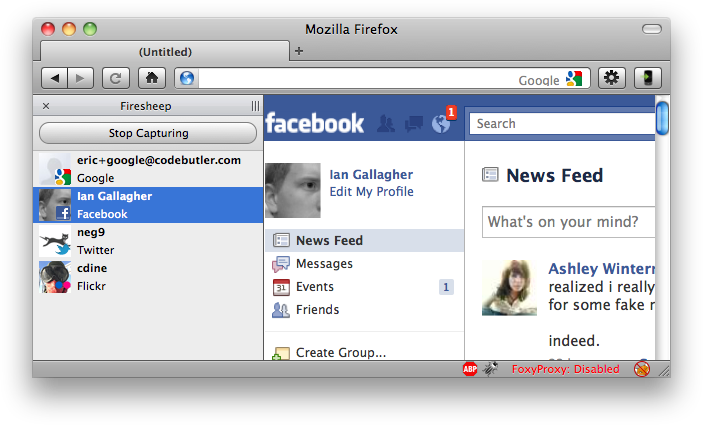
This session cookie exploit has been known for a long time now, but it used to be the domain of determined hackers with advanced tools most civilians would never know about. Firesheep is a one-click install for Firefox, and its graphical user interface is very easy to use. Butler created it not for evildoers to hack accounts, but to put pressure on companies to encrypt session cookies so that it can't be done.
Idiocy
A follow-up tool, called Idiocy, hijacks your Twitter session using the same unencrypted cookie hijacking technique and auto-tweets "I browsed twitter insecurely on a public network and all I got was this lousy tweet", with a link to a the Idiocy page, as shown above. The linked page explains what happened:
You just got your twitter session automatically hijacked by a piece of software, the intention is to warn you that your account can be modified without your permission. [...] To prevent this occurring in the future, make sure you ALWAYS visit twitter securely. You can do this by going to https://twitter.com, rather than http://twitter.com. It's the same as internet banking - look for the lock!
Idiocy is a bit more difficult to run than Firesheep, but its auto-tweet functionality gets the message across more effectively.
The Solution
Ultimately Firesheep, Idiocy and its ilk are a call to companies like Facebook and Twitter demanding that they encrypt all cookies, like Google's Gmail does. Until encrypted cookies become standard security practice--and hopefully the attention these tools brought to the issue will force these web companies' hands--you can protect yourself.
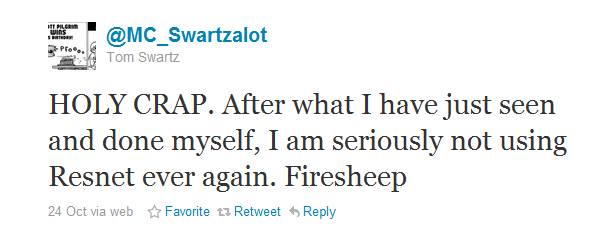
First and foremost, avoid open Wi-Fi networks where it's even possible for others on the network to sniff the traffic your computer's sending and receiving to various sites. When you must hop onto open Wi-Fi, use an https connection for every site you possibly can. The Force TLS Firefox extension tells your browser to use https by default.
Reached for comment, a Facebook spokesperson tells Fast Company: "We have been making progress testing SSL access across Facebook and hope to provide it as an option in the coming months. As always, we advise people to use caution when sending or receiving information over unsecured Wi-Fi networks. This tip and others can be found on the Facebook Security Page." The spokesperson added, "Be careful about the information you access or send from a public wireless network. To be on the safe side, you may want to assume that other people can access any information you see or send over a public wireless network. Unless you can verify that a hot spot has effective security measures in place, it may be best to avoid sending or receiving sensitive information over that network."
The FTC's OnGuardOnline site also offers a warning.
Twitter promised Fast Company a response later today. Other services did not respond to requests for comment in time for this post. When they do, we'll update it.
While there will most certainly be collateral damage due to the release of Firesheep and Idiocy, if the long-term effect is that all web companies use SSL for cookies, it will be worth it. Now, webapp makers, go forth and secure your cookies!
Gina Trapani is changing her passwords and resetting her browser cookies just in case. Follow @ginatrapani on Twitter
The Future of Local Commerce = Facebook + Foursquare + Yelp + Groupon
I tend to believe that local advertising will follow the description outlined in this article. The combination of these socially empowered, locally focused, geo-targeted and cost efficient mediums to connect consumers with advertisers is unique. More than that, it could be game changing. I've been following this trend closely and it is worth watching... the future is closer than you might think.
There’s been much hype, crazy valuations, and overall market excitement about businesses that promise to unleash the power of the social graph, location, recommendations and group buying. Facebook’s latest valuation according to SecondMarket is now about $30 billion, Foursquare raised$20 million at a post-money valuation of $115 million while still at a pre-revenue stage, Yelp, short of selling for $550 million to Google, raised over $25 million at an undisclosed but very high valuation, and finally Groupon raised $135 million at a whopping $1.35 billion valuation. So besides their huge success with the investment community, and their users, what do these companies have in common, and what does all this have to do with disrupting Local Commerce?

In an August TechCrunch guest post, Alex Rampell, describes how Online2Offline commerce is a potential trillion dollar opportunity. The gist of it is that we spend most of our disposable income offline, in local stores, restaurants, and shopping malls. But companies like Groupon, Gilt, and other group buying and private sale startups are changing the money flow. People buy online, and redeem offline. But this is just the beginning of a perfect storm brewing that will change the way we discover, shop, and pay for things. Let’s focus on the main function each of these different startups provide to understand how bringing them together will ultimately disrupt multiple trillion dollar industries:
- Facebook: provides the Social Graph, which is fast becoming a utility. Through its open platform, and APIs, we share more about our lives and our interactions online and on mobile every day.
- Foursquare and Gowalla: provide location services and check-ins, along with game mechanics that motivate users to unlock badges, earn mayorships, and get discounts at local stores in the process.
- Yelp: provides crowdsourced reviews of local businesses. Now also provides check-ins, and offers.
- Groupon: provides discounted offers against a promise to increase sales and bring in brand new customers to local businesses.

The interesting thing here is that there’s a lot of overlap between the features offered by these companies. Recently, Facebook launched Places, a mobile geo-location service that mimics Foursquare local check-ins. Yelp also added check-ins, and recently rolled out Yelp Deals, a Groupon clone.
Considering that Local Commerce will be mostly mobile, one of these companies still must bring all of these features together, along with one-click payments (IMHO), to truly tap into the potential of all these disruptive technologies. In my mind, the ultimate product combines all these features in a mobile app. A user would launche the app, see what special deals are in her area (location + group buying), whom of her friends already bought the coupon/item (social graph), local reviews from friends (social graph + reviews), and then she could then buy the desired coupon in one click on her handset. She could walk into the local business with a discount code, barcode, or maybe at some point in the future, an enabled RFID tag, and redeem what she just bought.
All of these companies, with the exception of Yelp, are at an early stage of their product development in this space. Facebook Places is lacking the gaming mechanics of Foursquare, the reviews of Yelp, and the local deals of Groupon. Foursquare is missing scale in its discounted offers. Yelp is missing the reach of the social graph, and the embedded payments. Groupon is lacking core social graph features that would give it better relevance through social shopping.

So which one of these companies will succeed in unleashing the power of Local Commerce by combining the right set of features with the appropriate on-the-ground salesforce? My bet is on Facebook to be first. They have a large advertising sales organization that could reach out to local businesses, already are supposedly testing offers on Places, they have de-facto more distribution and social graph access than any of the other companies, and finally they are building a true payments platform.
Groupon and Yelp also have a decent shot at it, but it will be tough to compete with Facebook’s distribution capabilities and ubiquity. In order to remain relevant, they will have to innovate and come up with original features. Foursquare’s future is probably going to be more challenging with more players entering their space, but it it could end up being bought (once again for founder Dennis Crowley) by Google, which is preparing to aggressively go after the local commerce opportunity.
Techcrunch Editor’s note: The preceding guest post is by David Marcus, founder and CEO of Zong, a mobile payment provider for Facebook Credits, AT&T and hundreds of leading destination websites and mobile applications
Allen Iverson: Officially Bound for Turkey
Seems strangely appropriate...
Allen Iverson To Turkish Media: 'Uygulama? Uygulama? Biz Uygulama Bahsediyoruz!'

The word from the A.I. camp is out, and they’ve officially declared that they’re on their way to Istanbul. Larry Brown expresses the sadness that all Iverson feel today. From the Philly Daily News: “A media advisory sent last night said the former 76ers star agreed in principle to a 2-year, $4 million contract with Besiktas, a professional team in Turkey. He is expected to sign his contract this weekend and begin his overseas career the week of Nov. 8. Iverson is expected to attend a news conference at 2 p.m. today at the St. Regis Hotel in New York … ‘It’s sad, having him have to go to Turkey to finish his career,’ Larry Brown, his former Sixers coach, said the other day. ‘I wish there were some way I was in a position to help. You don’t want to see him end his career this way.’”
How To Make Innovative Ideas Happen
Steve Jobs said, "Innovation distinguishes a leader from a follower." Clearly, innovation drives intellectual, economic and technological growth. The article below from Smashing Magazine outlines a process to foster innovative thinking from conception to reality. I enjoyed reading it and hope you find it useful as well...

Anyone can come up with an amazing idea but how you execute the idea will determine your success.
Dear LeBron, It's not the critic who counts...
Dear LeBron,
I saw your commercial...
Let me share some advice that a wise president once said... words I live by,
"It is not the critic who counts: not the man who points out how the strong man stumbles or where the doer of deeds could have done better. The credit belongs to the man who is actually in the arena, whose face is marred by dust and sweat and blood, who strives valiantly, who errs and comes up short again and again, because there is no effort without error or shortcoming, but who knows the great enthusiasms, the great devotions, who spends himself for a worthy cause; who, at the best, knows, in the end, the triumph of high achievement, and who, at the worst, if he fails, at least he fails while daring greatly, so that his place shall never be with those cold and timid souls who knew neither victory nor defeat." Theodore Roosevelt
Now, go play ball.
Sincerely,
Tom
From Russia, With (Search) Love
Over the past few months I have had the opportunity to learn more about the current digital market and advertising opportunities in Russia from Person Carey who is heading up Yandex’s new business opportunities outside of Russia. While China often gets the attention for its growth and opportunity, Preston showed me that Russia can also offer opportunities for companies looking to expand their international reach.

Starbucks Stores in New York Now Accepting Mobile Payments
 I'm a big fan of mobile payments and Starbucks! So when the two come together it gets my attention. I've had the Starbucks Mobile Payment App on my iPhone for six months, hoping to find a store where I can use it, to no avail. Mobile payments make perfect sense. I rarely carry cash when traveling because of the risk. I always have my iPhone and would be perfectly comfortable paying with it.
Mashable, Starbucks has seen sufficient success with its Starbucks Card Mobile payment pilot program in select San Francisco, Seattle and Target stores that its ready to extend the program to nearly 300 company-operated stores in New York City and Long Island.
Starbucks Card Mobile for iPhone and BlackBerry lets users pay for their coffee by holding up the 2-D barcode on their smartphone to the scanner at the counter. The application allows customers to manage and reload their Starbucks Cards as well.

Customers have responded positively to the mobile payment option, Starbucks reports.
“We’re seeing more and more customers using their smartphones as their mobile wallets,” says Brady Brewer, vice president Starbucks Card and Loyalty. “We’ve heard from our customers on My Starbucks Idea that they want a faster, more convenient way to pay.”
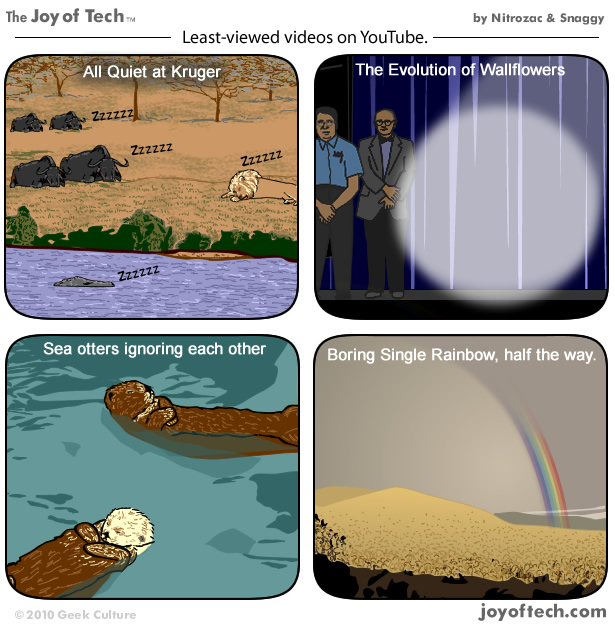
Least-viewed videos on YouTube (@JoyofTech)
Some things just make me laugh, especially the last one :)
Groupon Adds Self-Serve Deal Platform, Says It's the "Future"
Now Groupon is testing a new feature called Groupon Stores, which allows local businesses to create Facebook-like pages where fans can follow them and access deals. The businesses can add their own deals, bypassing Groupon’s long waiting lines in each city, but do they have more than enough to keep track of already? Each business that signs up receives its own page with a web address that begins “groupon.com/merchants/” and can offer details about itself along with deals similar to those hosted on the main section of the Groupon website. Only a few businesses are testing out the feature at present. I'm impressed with Groupon. Not as much as a consumer but from the business concept standpoint... quite frankly, it's brilliant. There's a reason this company has been the fastest to a $1B valuation (yep, faster than Google and Facebook!)
The Journey of Latavious Willaims
I met Latavious Williams last year through my involvement with Dutt Sports. Latavious is both a terrific young player and a very nice individual. I'm thrilled for him and his opportunity to play in the NBA. The story below shows his progress, leaving space for the next chapter.

Meet Latavious Williams. While many of his high school classmates were heading to college, the 6’8”-210 pound Williams decided to forgo the backpack for basketball shoes and pursue his dream of playing professional basketball. Despite the wide array of options that lay before him, Williams chose to enter the NBA Development League, making him the first high school graduate to do so. Playing for the Tulsa 66ers, Williams’s game is marked by length and athleticism and coaches were immediately impressed by his tireless work-ethic and eagerness to be a student of basketball.
What Earnings Reports Have Revealed About Ads
Cost per click is up, clicking activity way up. Good news for Google, bad news for advertisers...
From CBS News
Here are highlights of recent quarterly earnings reports from selected Internet, media and advertising companies and what they say about the state of spending on advertising: Oct. 14: Google Inc. says its average cost per click rose 3 percent from a year ago, meaning companies paid more to place ads. People clicked on ads 16 percent more than they did in the same period last year. Executives also indicate that display advertising accounted for nearly 10 percent of ad revenue in the quarter, and mobile advertising was almost 4 percent. Those figures helped justify two of Google's biggest acquisitions - of DoubleClick Inc. and AdMob. Oct. 15: Gannett Co. reports a 37 percent rise in third-quarter earnings on Friday, helped by a jump in broadcasting revenue. A recovering auto industry and political campaigns heading into midterm elections poured money into Gannett's 23 television stations. That, plus an increase in advertising on the company's websites, helped the biggest U.S. newspaper publisher halt declining revenue for the first time since 2006. Tuesday: The New York Times Co. and McClatchy Co. both report that print advertising fell compared with a year ago, when ad sales had already taken a big plunge from 2008 levels. And neither company was able to draw enough new business from its digital operations to make up for the losses in print. Yahoo Inc. says search advertising revenue fell 7 percent from last year to $331 million. But Yahoo generated slightly more revenue from each search in the third quarter, the first time that has happened in two years. The company fared much better in its stronghold, the "display" advertising category that covers banner and full-screen ads, sometimes featuring video. Revenue in this segment climbed 17 percent to $465 million. Among earnings reports coming up: Wednesday: IAC/InterActiveCorp Thursday: Microsoft Corp. Nov. 3: Time Warner Inc., AOL Inc. Nov. 4: CBS Corp. Nov. 5: Washington Post Co. Nov. 11: Viacom Inc., Walt Disney Co.
Birthday Freebies!
Today is my friend Don's birthday. As a public service, I thought I would post this handy dandy list of cool stuff you can get for free on YOUR birthday! From free pancakes to appetizers to coffee to ice cream... you get it all! Unfortunately, you will have to buy your own Alka-Seltzer :)

Everyone loves birthdays and everyone loves free stuff. Luckily for us, there are a ton of places out there that offer birthday freebies! I’ve compiled a list of some of the best birthday freebies out there. Remember that some places will want you to show proof, so be honest!
Alfy’s Pizza – Get a free mini pizza on your birthday.
Applebee’s – Free dessert and song on your birthday.
Austin Grill – Register for their eClub and get a free meal on your birthday.
Bakers Square – Get a free peice of pie on your birthday at Bakers Square.
Bandido’s – Get $10 off your favorite entree when you celebrate your birthday at Bandido’s in Ohio and Indiana.
Baskin Robbins – Baskin Robbins will send you a coupon for a free 2.5 oz scoop of ice cream on your birthday plus other special promotions when you join the Baskin Robbins Birthday Club.
BD’s Mongolian BBQ – Receive a free stifry on your birthday when you join Club Mongo.
Ben & Jerry’s – Get a free ice cream treat on your birthday when you become a ChunkSpelunker with Ben & Jerry’s.
Benihana - Join “The Chef’s Table” and receive a Benihana Birthday Dinner certificate worth $30 to use during the month of your birthday.
Bennigan’s – Get a buy 1 entree, get 1 entrée free and a free brownie ice cream dessert coupon on your birthday.
Black Angus Steakhouse – Get a free steak dinner on your birthday when you join the BA Prime Club. You also get a complimentary dessert for signing up for the club.
Blimpie – Get a coupon for a free 6” sub on your birthday at Blimpie’s.
Blue Bell – Members of the Blue Bell Country Club will receive a gift certificate for a free half gallon of Blue Bell Ice Cream during the month of their birthday.
Bob’s Big Boy – Get a free hot fudge ice cream on your birthday.
Bob Evans – Sign up your child for their birthday club and they’ll get a free kids’ meal on their birthday at Bob Evans.
The Body Shop – The Body Shop will give you a free birthday gift up to a $10 value during the month of your birthday. **No longer valid**
Boston Market – Kids 12 and under will receive a birthday coupon good for a free kid’s meal, drink, and dessert at Boston Market.
Buffalo Wild Wings – Get a coupon for a free dessert to celebrate your birthday at Buffalo Wild Wings.
Burger King – Sign up your child to be a member of Club BK so they can get a free kid’s meal on their birthday.
California Pizza Kitchen – Sign up your child (10 and under) for CPKids and they will receive a free CPKids meal during the month of their birthday.
Captain D’s – Kids get a free kids meal and birthday greeting on their birthday at Captain D’s. Adult’s can join the D’s Club and get a coupon for a free birthday meal.
Caribou Coffee – Create an account and be sure to update it with your birthday. They will send you a coupon for a free coffee drink on your birthday.
Carrows – Join the Carrows E-Club to get a free dessert on your birthday as well as one for joining.
Cattlemen’s – Join the Cattlemen’s E-Club and get a free dessert when you come in on your birthday.
Charlie Brown’s Steakhouse – Get a free gift on your birthday as a member of the Charlie Brown’s Handshake Club as well as gift vouchers and special members-only events.
Chevys – Join Chevys Compadres Club and get a free dessert on your birthday.
Claim Jumper Restaurant – Join the CJ E-Club and get a free dessert on your birthday.
Cold Stone Creamery – Cold Stone Creamery will send you an email with a coupon for a free ice cream creation to enjoy on your birthday. All ages are welcome!
Country Buffet – Join the eClub and get a free birthday coupon in the mail.
Cracker Barrel – You can come into Cracker Barrel on your birthday and you will get a free dessert and song.
Crazy Buffet – Bring a friend and your ID into Crazy Buffet on your birthday and get a free dinner buffet.
Dairy Queen – Join the Dairy Queen Blizzard Fan Club and get a free ice cream cone on your birthday as well as a coupon for a blizzard when you join.
Dave & Buster’s – Get a free $5 game card credit on your birthday.
Denny’s – Come in and get a free Grand Slam on your birthday.
Desparados Mexican Restaraunt – Come in and get a free meal at Desparados on your birthday.
Discovery Cruise Line – You get a free one-day cruise from Ft. Lauderdale to the Bahamas. You do have to make the trip with another fare-paying adult and will have to shell out the $20 for the Bahama departure and harbor fee.
Disneyland – Get free admission on your birthday when you register in advance. You will need to bring the confirmation along with your ID to the park. **No longer valid**
Dockside Restaurants – Get a free meal on your birthday.
Duke’s ChowderHouse – Get a coupon for a free lunch or dinner entree on your birthday when you sign up on Duke’s website.
Dutch Bros. Coffee – Stop in on your birthday and get a free coffee as your birthday freebie.
Famous Daves BBQ – Free food coupon via email on your birthday when you join the Famous Dave’s P.I.G. Club (could be free cake, an appetizer, or some ribs!).
Firehouse Subs – Jon the Firehouse Subs Birthday Club and enjoy a free sub on your birthday.
First Watch – Join the suneclub and receive a coupon for a free entree at First Watch.
Friendly’s – Sign up for Friendly’s E-News and get free ice cream for your birthday. This is now for kids and adults!
Fuddruckers – Join the Fudds Club and gett a free burger on your birthday. (May not be available in all areas.)
Garozzo’s Ristorante – Bring in your driver’s license to get a free spedini meal at this Kansas City eatery.
Grimaldi’s – Sign up for the birthday club at Grimaldi’s and get a free pizza.
Hana Japan – Get a free birthday lunch or dinner when you bring in 4 or more people on your birthday.
Hard Rock Cafe – Come in and get a free dessert on your birthday.
Helzberg Diamonds – Sign up for free email updates at Helzberg Diamonds and receive a coupon for free pearl earrings for your birthday.
Hollywood Video – Get a free rental at Hollywood Video on your birthday with card membership. In fact, anyone on your account can get a free rental on their birthday.
Hometown Buffet – Join the eClub and get a free birthday coupon in the mail.
Houlihan’s - Join Houlihan’s email club and you’ll get a coupon for a free entree on your birthday. Or if you’re not a member you can still stop in a get a free dessert.
IHOP – Come on into IHOP and get a free meal (a sundae at some locations) on your birthday. (May not be available in all areas.)
Joe’s BBQ – Visit Joe’s BBQ (AZ) on your birthday and receive a free meal.
Joe’s Crab Shack – Go to Joe’s Crab Shack on your birthday and get a free piece of cake.
Lone Star Steakhouse – Sign up for the Lone Star Steakhouse e-club and you’ll receive a coupon for a free entree (up to $15 value) to help you celebrate your birthday. **No longer valid.**
Lowry Park Zoo – If you’re a Florida resident and go to Lowry Park Zoo (Tampa, FL) on your birthday, you’ll get free admission.
Luby’s - Free kid’s birthday meal (ages 9 and younger) on their birthday as a member of the Luby’s birthday club.
Macaroni Grill – Come on into Macaroni Grill on your birthday and get a free dessert plus a song.
Maggiano’s – Join the Maggiano’s Birthday Club and get a coupon for $10 off your meal purchase.
Marie Callender’s – Join Marie Callender’s E-Club and get a coupon for $5 off your meal and piece of pie when you visit during the month of your birthday.
McDonald’s - Free Happy Meal for your child on their birthday. This offer is only good at participating McDonald’s in Colorado, Greater Las Vegas Area, Western Nebraska and Wyoming.
Memphis Barbecue – Receive a coupon good for a free rack of ribs and a dessert when you join the free eClub.
Moe’s Southwest Grill – Get a coupon for a free Moe’s entree (excludes fajitas) on your birthday when you choose to “stay in the moe.”
Noodles & Company – Join the Noodleville Noodlegram to get a coupon for a free dish on your birthday.
Olan Mills Portrait Studios – Get a free Olan Mills portrait package that includes (1) 8X10, (2) 5X7 and (8) wallets when you join the birthday club.
Old Country Buffet – Join the eClub and get a free birthday coupon in the mail.
Old Spaghetti Warehouse – Join the Warehouse Club and get a coupon for a free meal on your birthday.
On the Border – Get a free appetizer on your birthday when you join On the Border’s Club Cantina. When you initially join you will get an instant coupon for a free bowl of queso or empanadas.
Outback – Get a free dessert and a song when you go to Outback on your birthday.
P.F. Changs – Come in and get a free dessert on your birthday.
Pancho’s – Join Pancho’s Birthday Club to get $10 off the bill for adults or $5 off the bill for kids.
Perkins – Receive an email for a free kid’s meal and birthday greeting on their birthday when you sign them up for the Bakery Buddies Kid’s Birthday Club. Adults can get an email coupon for a free piece of pie.
Provino’s – Come on into Provino’s on your birthday and show your ID to get a free pasta speciality dinner (which includes salad, garlic rolls and a birthday dessert!).
Red Lobster – Join the Overboard Club and they will email you a suprise for your birthday.
Red Robin – Join the Red Robin eClub and get a coupon for a fee burger on your birthday. This is for all ages!
Rock Bottom – Join the Mug Club and get a free appetizer on your birthday.
Round Table – Get a free personal pizza when you visit on your birthday.
Ruby Tuesday – Ruby Tuesday now has a birthday freebie. Join the So Connected club and you’ll get an email for a free burger on your birthday.
Ru Sans – Visit Ru Sans to sign up for their birthday card to get free food on your birthday.
Ryan’s – Join the eClub at Ryan’s and get a coupon for a free adult buffet with the purchase of another adult buffet during the month of your birthday.
Sephora – Sign up as a Beauty Insider and get a free gift from Sephora on your birthday.
Shoney’s – Get your child (10 and under) a free kid’s meal on their birthday when you sign them up for the the Kids Club.
Psychologists now know what makes people happy
By Marilyn Elias, USA TODAY
The happiest people surround themselves with family and friends, don't care about keeping up with the Joneses next door, lose themselves in daily activities and, most important, forgive easily.
Yep, Apple Killed The CD Today
By MG Siegler, Techcrunch Stop. Take a deep breath. Before my headline gets you all worked up, consider what I’m saying here. The CD and other optical discs, like DVDs and Blu-rays, are obviously going to live on for a while as a way to transport media. But make no mistake that today, with two unveilings, Apple has effectively sealed the fate of the optical disc in the computer industry. Soon, it will go the way of the floppy disk. Last week, I wrote a post laying out what I hoped Apple would bring with a revamped MacBook Air. I came to the realization that I had never once used the optical drive in my current MacBook Pro, and it was simply taking up a lot of space and was making my computer unnecessarily bulky. I wanted to replace it with a MacBook Air. And now I can. And I’m not going to be the only one that does. Now, I know what you’re thinking: but the MacBook Air has been around for a couple of years and it hasn’t killed off the optical disc yet. That’s true, but a couple key ingredients were missing the last time around. First of all, the first-generation Airs were a bad combination of underpowered and overpriced. That is no longer the case. Second, they required some convoluted desktop computer CD syncing system to be able to install something from an optical disc to the Air (or an optional USB add-on). That is also no longer the case (though both still exists). When you get your MacBook Air and you open the box, you will find exactly zero optical discs inside. Normally, Apple includes at least one back-up DVD to reinstall OS X and other software if your computer fails. But now, that has been replaced with a super-slim USB stick. This stick, packed in with your manual, is all you need to reinstall your system now. This makes a lot of sense. CDs were replaced by DVDs because they offered a lot more storage. But flash memory cards, such as the one Apple includes with the Air, are already blowing DVDs out of the water when it comes to storage. They may still be more expensive to produce, but Apple has clearly figured out a way to make it work. I suspect we may see more drives like this one (which use much less plastic than typical USB flash drives — and appear to even use less plastic than optical discs). But that’s only one half of the future. The other half is a potentially much bigger announcement Apple made today: the Mac App Store. While Apple didn’t give a ton of details yet, it appears that this store will work pretty much just as their App Store does on the iPhone, iPad, and iPod touch. There will be free and paid apps. There will be one-click downloads. There will be automatic updates. All that. What there won’t be are any optical discs. Up until now, the vast majority of software (at least the legal variety) has been distributed by way of CD or DVD. The Mac App Store could very well change that. Every app found on that store, undoubtedly including the big ones we all know and love and use on our computers today, will be distributed over the Internet. This is long overdue. Plenty of companies have tried Internet distribution for a long time. Some have success, and some don’t. But none have the type of central repository that Apple is offering here. This is going to be huge. If it sounds similar to what Google is working on with the Chrome Web Store, or what Mozilla is proposing with their Open Web Ecosystem, remember that those are only webapps. We’re talking native applications for the Mac App Store. We’re talking apps that run on your computer, just like you have now, they’re just distributed in a way that makes a lot more sense. They’re distributed in a way that makes the CD, DVD, and every other optical disc obsolete. And that’s good, since soon the optical drives will start to fade out of existence as well. With the launch of the iTunes Music Store seven and a half years ago, Apple put the wheels in motion to kill the CD. Today, they kicked off their final assault. There will be no survivors.