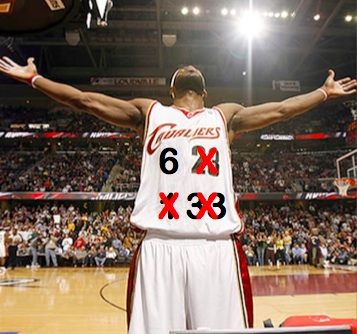

MIAMI—After much deliberation,members of the MiamiHeat.com web team decided today that the featured homepage image should depict Miami Heat small forward LeBron James playing basketball. According to sources, the choice to go with a photograph of James was made in an early morning staff meeting. Several different image ideas were suggested, including LeBron James shooting a basketball, LeBron James passing a basketball, and LeBron James playing defense in a basketball game. The selected photo will reportedly replace yesterday's picture of LeBron James standing on a basketball court and dribbling a basketball with one hand while pointing with the other. "We like today's photo because it's an action shot, it's vibrant, and you can tell the crowd in the background is really enjoying the game," web editor Mark Christie said. "And it has LeBron James in it, as well." "He's dunking," Christie added. Christie told reporters that on any given day, his colleagues have a rough idea of which Heat player or players they want to feature on the website. Monday—according to Christie a high-traffic day—is typically reserved for a picture of LeBron James. On Tuesday, Christie said he likes to go with an alternate image of LeBron James. And on Wednesday, the web team typically selects a LeBron James picture that strikes a tone suitable for the site's midweek audience. Thursdays, however, Christie said he likes to change it up by going with a picture of Dwyane Wade and LeBron James either laughing with each other, staring intensely at the action on the floor, or sitting next to each other on the bench. Weekends are reportedly reserved for a three-shot of Wade, newly acquired forward Chris Bosh, and LeBron James, in which James is standing between the two holding a basketball.† "Sometimes that weekend schedule goes completely out the window, though, and we'll just go with a picture of LeBron James," said assistant web editor Jarrod Brewer, adding that single images of Chris Bosh can be found on the website's "photos" page. "Especially if we have a really good photo of him. People would be surprised how often that happens. It's ultimately very fluid around here. Last Friday we were slated to have a photo of Chris Bosh and LeBron James, and then Mark said, 'It feels like a just-LeBron day to me. Let's go with him sweating.'" Continued Brewer, "Also, I thought Mark's decision to go with LeBron James standing at a podium after a preseason game instead of a picture of Coach, um, Coach—the coach of the Miami Heat basketball team, yeah—was a really good call on Mark's part." According to Christie, the main goal of MiamiHeat.com is to make the website feel like a unique experience for daily visitors. That is why, Christie noted, he likes to constantly change up the photos of LeBron James. If, for example, Christie uses a picture in the morning of the All-Star forward throwing chalk into the air, then during the afternoon he'll go with a more subdued photo of James sitting on the bench with a towel draped across his knees, drinking a cup of Gatorade. "Mix is really important to me," Christie said. "If we go two days in a row with LeBron James smiling, then I'm not doing my job." When asked why a photo of 16-year veteran Juwan Howard was featured in the site's top spot several weeks ago, Christie said that the incident was a huge mistake, that the person who posted it was immediately fired, and that the page was actually intended to feature LeBron James.
USA Today: Escalating click fraud erodes credibility of online advertising
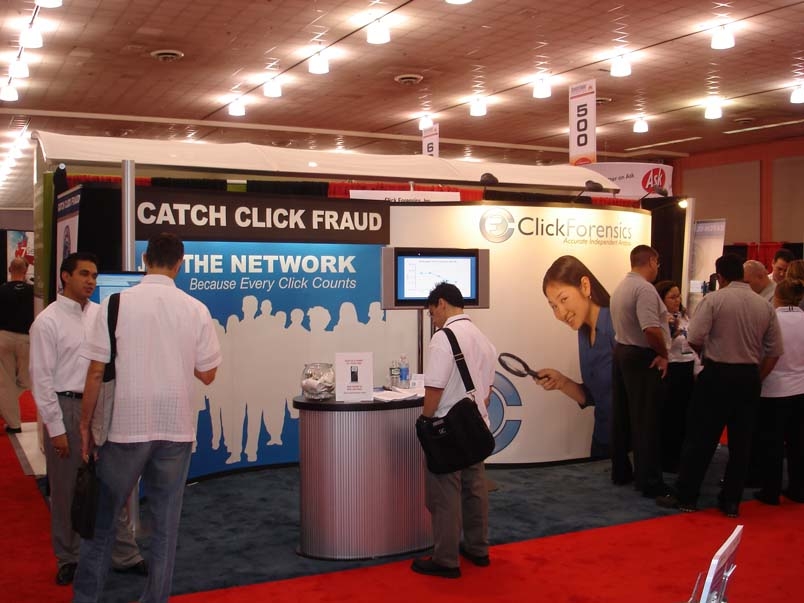
The level of fraudulent clicks on legit online advertisements rose to 22.3% in the third quarter, ending September 30, according to summary findings released today by online ad tracking firm Click Forensics.
That's up from 14.1% during the same three months of 2009. "During the past quarter, we saw a growing volume of click fraud flow through a more diverse number of sources," says Paul Pellman, CEO of Click Forensics. "As advertising in videos, social networks and mobile devices continues to grow, advertisers will need to pay close attention to the quality of traffic they receive."
Advertisers have wasted tens of millions of dollars on faked clicks, as we reported in this story.
Most often, cybercriminals put up websites carrying online ads and no other content. The criminals then retain the services of cybergangs in control of sprawling networks of infected PCs, called botnets, which are directed to repeatedly click on the ads. This triggers payments to the crooks who put up the Web page.
Click fraud continues to steadily erode the credibility of Internet-based advertising, which is why Microsoft has declared war on cybercriminals who specialize in click fraud, as we reported here.
Context supplied earlier this year by Brad Smith, Microsoft senior vice president and general counsel, bears repeating.
Smith told reporters at a press briefing in May that criminals are "not alone" in getting rich. Smith outlined how Google, Microsoft and Yahoo, the biggest online advertising platform providers, also profit from click fraud, since each also gets a piece of the payment advertisers pay for each faked click.
The tech giants can "take aggressive steps" to stop click fraud, "or look the other way and make money on it," noted Smith. "We don't believe looking the other way is an option."
By Byron Acohido
Click Fraud Rate Rises to 22.3 Percent in Q3 2010
Now in its fourth year, the Click Forensics reporting service provides statistically significant data collected from Cost Per Click (CPC) advertising campaigns for both large and small advertisers across all leading search engines as well as comparison shopping engines and social networks. Traffic across more than 300 ad networks is reflected in the data. Key findings for Q3 2010 include:
- The overall industry average click fraud rate was 22.3 percent. That’s up from the 18.6 percent reported for Q2 2010 and the 14.1 percent rate reported for Q3 2009.
- In Q3 2010, the countries outside North America with significant CPC traffic producing the greatest volume of click fraud were Japan, the Netherlands, the Philippines and China, respectively.
“During the past quarter, we saw a growing volume of click fraud flow through a more diverse number of sources, including mobile proxies,” said Paul Pellman, CEO of Click Forensics. “As advertising in videos, social networks and mobile devices continues to grow, advertisers will need to pay close attention to the quality of traffic they receive.”
Since 2006, Click Forensics has published online advertising industry data collected from the first independent third-party Cost Per Click (CPC) and online advertising fraud detection service. The service monitors online media traffic across over 300 ad networks as well as billions of clicks from top search engines, comparison shopping engines, social networks, leading publishers and advertiser web sites – providing the most accurate view of online advertising audience quality.
For more details, visit http://www.clickforensics.com/resources/click-fraud-index.html.
Facebook performance art... very funny :)
From One Addiction to the Next: Starbucks To Offer Beer and Wine
http://newsfeed.time.com/2010/10/19/from-one-addiction-to-the-next-starbucks-to-offer-beer-and-wine/(Sent from
2012 Mayan Calendar 'Doomsday' Date Might Be Wrong : Discovery News
According to all the ridiculous hype surrounding Dec. 21, 2012, the Mayans "predicted" the end of the world with one of their calendars. On this date, doomsayers assert that Earth will be ravaged by a smorgasbord of cataclysmic astronomical events -- everything from a Planet X flyby to a "killer" solar flare to a geomagnetic reversal (I hate it when those happen!), ensuring we have a very, very bad day.
And now, according to a recent study by an associate professor at UC Santa Barbara, this fundamental "end date" may also be inaccurate. It could be at least 60 days out of whack.
60 days! This throws everything off... read more here:
Dual 'hook 'em horns' sign caused Dallas penalty, not leapfrog
BUSTED: Wall Street Journal Catches Facebook, Zynga Giving Your Info To Advertisers
http://pulsene.ws/9w94

The latest in the Wall Street Journal's series on online privacy targets Facebook and Facebook app makers like Zynga. This is a problem many in the industry have been aware of for some time.
Helping Travelers Find Internet-Connected Flights
BITS | OCTOBER 15, 2010
http://pulsene.ws/9pan HasWifi lets people know if a particular flight offers Internet access.
Venture Capitalists, Super Angels and the State of Startup Funding
How the iPad Changed My Life :)
iPad Pre-ordering Fun
Surfing at 32,000 ft.
Netflix Movie Streaming Hookup
Moving Forward by Stepping Back
In April of 2005 I sat at my usual corner table at Krispy Kreme donuts in San Antonio.
- We raised awareness about click fraud – Sure we may have ruffled a few feathers when we
I have enjoyed the opportunity afforded me to play a role in our company and the industry. I'm deeply appreciative of the support, encouragement and hard work from our employees, partners and board of directors. It's been an amazing five year ride! And so now I look ahead. Currently, I’m enjoying an “entrepreneurial sabbatical” to consider options and explore opportunities over the next few months. I’m enjoying time with friends and family, traveling and learning about new businesses. I’m keeping busy by consulting with an advertising technology company, joined the advisory board of an NBA agent firm and of course reading, writing and learning. At some point, I’ll head back to Krispy Kreme. There are an unlimited supply of donuts, coffee and problems to solve. I can’t wait~ Tom Cuthbert