



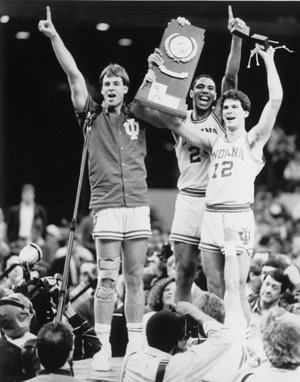
I am a fan of competition. The idea of pitting one team versus another or better yet, one person against another is both entertaining and healthy. Competition is good for business, good for our economy and good for sports. Life lessons can be learned from winning and losing and competition drives success.For me, March Madness is the quintessential competition. It is a pure and simple format that fairly matches teams against in each, generally on neutral sites. 65 teams in a single elimination, winner take all format with no consolation games. 31 teams get an automatic bid by winning their conference and the remaining teams are selected based on merit. There is no ridiculous controversy like, "South Dakota State would have won it all if they had just gotten the 65th spot". These are the best teams in the country... period.
There is no doubt there are problems with college basketball. Graduation rates are low, gambling is prevalent and players sometimes misbehave. But generally the sport is clean, the players are committed and the game is fair.
After a season lasting months and a tournament lasting weeks, it all comes down to one game... a true championship game (do you hear me BCS?). There is something pure and honorable about a format that enables the two teams that have made it through the competition to face each other in one final game. That... is quintessential competition.
March Madness is just around the corner. So bust out your bracket, sit back and enjoy the ride. Once again this year, it will be a great spectacle of upsets, buzzer beaters and quintessential competition. And by the way, the odds of getting your bracket perfect are 9,223,372,036,854,775,808 to 1... good luck with that!
Tom
Why I Like Amtrak
OK sure Amtrak only exists because the government props it up. The subsidy actually comes out to $210 for every 1000 passenger miles. For those folks who live in a giant state like Texas, the idea of taking the train anywhere is nuts. However, for people on the east coast, it works brilliantly. I actually enjoy it get much more done on the train than I would on most flights.

This trip, for example, I flew nonstop to Baltimore for a meeting. Then, it is a easy 2 1/2 hour train ride on the Acela and poof, you are in midtown Manhattan. There are three things I like about Amtrak vs flying:
1) No security lines (Sure it's fun to remove de-rob and wait in long lines but I am willing to sacrifice it to ride a train!)

2) No screaming babies in the seat behind me (I almost always choose the "quiet car")
3) Outlets! It's hard enough to find a plug at an airport (ie Las Vegas), on the train I have my very own
I have put together this fascinating two minute video of my most recent trip... enjoy :)
Yes, my trip cost the government (meaning me) $41.72. Despite that, I am glad Amtrak exists and will continue to enjoy it on the east coast. San Antonio to Lubbock? Not so much...
Happy travels!
Tom
If I could change just one thing about Google, it would be...

We all love Google but nobody's perfect! We hear suggestions all the time from advertisers that start, "If I could change just one thing about Google, it would be..." It was this type of feedback that lead to the Click Quality Council's "Eight Principles to Ensure Click Quality". We shared this list with Google and Shuman took time to respond with some great feedback. Last Fall, we released a Report Card, providing an update on how Google and others are doing on the Eight Principles.
So I thought, let's compile a new list! Send me your thoughts and I will share them back with you and with Google. To make it easy, just jot your idea, comment or suggestion in the box below. Thanks!
[contact-form]
Tom Cuthbert
Insight into the Jump in Click Fraud

This morning, Click Forensics released the Click Fraud Index numbers for Q4 2008. The overall rate jumped to 17.1%. This means that across our community of advertiser data, we find that one out of every six clicks are invalid and not worth paying for. There were three factors that drove the increase.
[caption id="attachment_303" align="alignright" width="300" caption="Source: Click Fraud Index"][/caption]
First, the increase lines up with past increases in Q4, somewhat of a seasonal bump. This year however, was magnified by the economic downturn and a correlating increase in cybercrime. I wrote about this last week.
Secondly, there was a 14% increase in the botnet rate, surpassing 30% for the first time. There have been quite a few reports from McAfee, Symantec and others noting a similar trend. Botnet attacks are becoming more sophisticated and difficult to stop.
Finally, for the first time in awhile, we saw an uptick in click farm activity. Unfortunately, there lots of sites that pay people to click on ads. This type of activity is difficult to catch and unfortunately, advertisers lose when this occurs.
While the jump is alarming, there is a growing current of cooperation to address the problem. At Click Forensics, we continue to work with advertisers, agencies and ad providers to build solutions to ensure advertisers get what they pay for.
Coverage of the news can be found here:
Tom
A Lesson in Sportsmanship

Without question, one of the greatest coaches in my lifetime has been John Wooden. With ten championships over a twelve year period, no one would question Coach Wooden is among the best. Ask any player who played for the "Wizard of Westwood" and you will learn they all learned more about life than about basketball. It was Wooden who said, "Sports do not build character. They reveal it."
Character has been revealed through sport in a game played in Dallas where Covenant defeated Dallas Academy 100-0 on Jan. 13. Leading 59-0 at the half, the team continued to shoot three-point shots and press on defense. Credit goes to Dallas Academy for never giving up. I was struck by their attitude and desire to improve shown in this video from the Dallas Morning News.
While not a point was scored by the team it's clear to me that there was a point made. After the fact, the Covenant team players and coaches apologized and offered to forfeit the win. Lesson learned. Wooden is right, sports reveal character... in both winning and losing. The key is learning to apply those lessons to life.
Wooden went on to greatness not because of his knowledge of basketball, but because of his perspective on life. Let me leave you with John Wooden's Seven Point Creed, given to him by his father Joshua upon his graduation:
- Be true to yourself.
- Make each day your masterpiece.
- Help others.
- Drink deeply from good books.
- Make friendship a fine art.
- Build a shelter against a rainy day.
- Pray for guidance and give thanks for your blessings every day.
Getting an Uptick in a Downturn

It's no secret our county’s economy is slowing and times are getting tough. While there is great optimism, there is an undercurrent of concern. In anytime of economic downturn, one unwanted byproduct is that crime increases ("Statistics point to increase in crime"). Unfortunately, this includes cyber crime and specifically, click fraud.
For almost three years now Click Forensics has been tracking click fraud. While the overall rate somewhat stabilized during 2008, the number of advertisers affected and the dollars lost continue to rise. As we face more sophisticated attacks in 2009, I wanted to highlight some recent advances in the battle and share some specific steps advertisers can do to ensure they get what they pay for.
Cooperation has been a theme for 2008. Progress is being made on three fronts by leaders in the industry. First, the Interactive Advertising Bureau (IAB) continues its work on defining guidelines for counting clicks. Click Forensics continues to take an active role in this important effort and supports it as a good first step. Secondly, leading search providers, including Google and Yahoo!, have enhanced their products with better tools to manage campaigns and announced traffic quality centers to provide additional resources to advertisers.
The third initiative has been the joint effort of Click Forensics and Yahoo! to build the FACTr process (Fully Automated Click Tracking Reconciliation). For years, advertisers have been frustrated when they have found invalid activity in their pay per click campaigns. Now there is a simple, automated process that connects advertisers to the ad providers. The FACTr system was built by Yahoo! and Click Forensics and launched publicly in July of 2008. By the fall, other ad providers including LookSmart, Miva and Google were added.
While progress continues, here are specific steps advertisers can take to protect their online investment. First, advertisers should monitor campaign performance at the most granular level. Click fraud attacks come in spikes of activity. By watching campaign performance on a daily basis, advertisers can see anomalies and alert the ad provider quickly. Looking for spikes in clicks, drops in conversion ratios, and higher than normal impression levels are all signs something may be out of line.
Secondly, now is a good time to double check campaign settings. A large number of unwanted clicks come as a result of campaigns not being set up correctly. Look at geo-target settings to ensure they match your campaign goals. Review day part settings to ensure you have optimal ad delivery for delivering quality traffic.
Finally, avoid paying for clicks from low quality traffic sources. By utilizing the site exclusion functionality made available by ad providers, you can block bad clicks from ever getting to your campaign. Click Forensics has a process called, Intelligent Exclusion™ that dynamically identifies bad traffic sources and eliminates them from the campaign. We see a 43.5% decline in the overall invalid rate for advertisers who use this process. Keeping the money in your pocket is always better than having to go back and ask for a refund!
Like you, we are hopeful that the economy will make a quick recovery. As it does, we will all benefit. In the meantime, it’s more important than ever that advertisers are on the lookout for threats to their ad budgets. You can count on all of us at Click Forensics to continue to work on behalf of the entire industry to bring solutions to the marketplace to ensure advertisers get what they pay for.
Tom
LOST: Simply the best show on televison

While I'm not a huge TV fan, I do like to watch sports, news and Seinfeld reruns. It has been a long time since there was a series that interested me enough to pay attention week in and week out. In September of 2005 I had rotator cuff surgery on my shoulder. I came home from the surgery the day that LOST had the recap episode from season one and the first episode of season two. As I lay on my side, somewhat drugged up, I watched and immediately became hooked.

LOST interests me for three reasons. First, the show is extremely well acted. Michael Emerson is amazing and well deserving of his Emmy nominations. Other actors on the show are equally engaging. There is an interesting mix of science fiction, action, romance and even comic relief. The balance built by the producers and delivered by the actors is impressive.
The second aspect of LOST that I like is the plot. It is incredibly complex and woven together by interesting dialogue, unexpected twists and turns and intense dramatic moments. I am not easily impressed, but the story of LOST has kept me guessing now for several years. I have no idea where it will end but am confident that all aspects are well thought out and will converge in a way that makes sense to me.
The third part of the show that I find remarkable is the music. The intensity of the drama and action is magnified by music that penetrates your mind in a way that draws you in. It fits perfectly with the plot and enhances the experience instead of distracting from it. There are two types of music on the show. There is the amazing background music played as the drama unfolds. Then there is the music that is filled with clues to help unlock the mystery of the show. Songs like "Walking After Midnight" and "Building a Mystery" lead to clues to the the show. Others such as "Good Vibrations" or "Xanadu" offer a fun way to break the intensity of the show.
There are a million little clues embedded in the show LOST. Watching them unfold and try to piece the show together has become a fun pastime the last few years. I even supplement my LOST watching with LOST listening to podcasts. ABC has an excellent podcast and I enjoy listening to Jay and Jack, two guys that comment on the show in an entertaining way.
So if you have not gotten "lost" its not too late! The show starts again this week for season five and concludes next year. There is a definite end point and while it will take some time to get caught up, it is well worth it. Two thumbs up for ABC on LOST and I look forward to seeing the last 32 episodes play out. Then, I guess it will be back to Seinfeld reruns :-/
Tom
"Digitize Me" Take Aways...

I enjoyed leading the seminar, "Digitize Me: Practical and Useful Tips for an Online World". I wanted to provide links to the presentation as well resources. They are all listed below.
Digitize Me
View presentation.
NBC Today Show - "OMG My Mom's on Facebook!"
Handouts:
Social Networking Summary
Students Rules for Online Safety
Family Contract for Online Safety
USA Today article ' "Kids Reveal a lot about themselves online"
Resources:
Social Networking: A Parents Guide (FTC)
MySpaceMyKids
NetSmartz.org
WiredSafety.org
The Child Safety Network
GetNetWise.org
SafeTeens.com
Books:
MySpace Unraveled
MySpaceMyKids
Facebook for Dummies
Monitoring Software:
CyberPatrol
CyberSitter
NetNanny
Facebook Poll Question

I've been asked to teach a Facebook seminar and have been working on it over the holiday.I'm curious as to how others are using Facebook, please take a moment and answer the question below. I'll share results and my presentation in a future blog post. Feel free to add a comment... thanks!
[polldaddy poll=1249020]
Jack FM, Not Your Father's Radio Station

Let me be clear, I really don't like commercial radio. I spend a lot of time in my car and usually listen to podcasts. (Some of my favorites include the LOST Podcast with Jay and Jack, The Onion Radio News and Today in iPhone). No commercials, I listen to what I want when I want and it's always fresh... three things radio is not! Sometimes I will listen to CD's or music on my iPod but rarely the radio, when I do... it's sports talk.Somehow, I stumbled onto Jack FM. I have to say I like it! Rarely do I hear the same song twice and the variety is amazing. I have fairly diverse tastes in music (ranging from Rascal Flatts to Van Halen to Pavarotti). Jack FM seems to play a little of everything (minus the Pavarotti!). I learned today that Jack FM has over 50 stations nationally (and a few around the world). Interesting concept that seems pretty efficient.
So wherever you are, there may a be a Jack FM near you. Tune in, crank it up and dance away... unless of course you are driving~
Tom
Connections, Followers and Friends... Oh My!
I’ve been studying and thinking about social media. I began studying social media for purely business reasons in early 2008. I was wondering how Facebook got its start, what Twitter can do to make money and why no one is using MySpace anymore. I read several books, nosed around the net and jumped onto several sites. Today, I use social media a lot and it has become woven into my everyday and workday life.
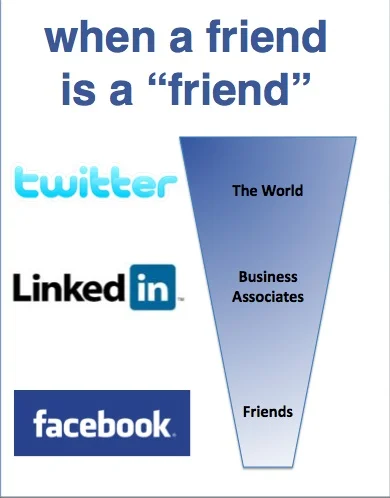
Essentially, there are three sites I use and each serves a different purpose.
I’ve been on LinkedIn for several years and it has become the place for my “real world” work connections. I have 427 connections and can honestly tell you I have personally met almost every single one. I typically don’t accept requests from people don’t know. It has been a valuable tool to connect others for business reasons. I manage my network by trying to be helpful with networking requests and frequently contact people through LinkedIn. I like it, for what it is. Some of the recent app additions (Wordpress, TripIt, Amazon Reading List…) are quite useful. LinkedIn succeeds because you can manage your network by both contributing to and benefitting from your connections.
I joined Facebook in early ’08 because it seemed to be the thing to do. My daughters have been on it for years, along with MySpace. As a parent, I have always disliked MySpace. It was way to easy to hack protected profiles and kids were prone to put stupid information (ie. home phone numbers) on the site. While they have cleaned up their act from a security standpoint there is no doubt they are losing ground to Facebook.
I was surprisingly impressed with the Facebook community and tools. The first issue I had was who to be “friends” with. My daughter initially wanted nothing to do with me in “her world”. Most of my real friends my age could care less about Facebook. I found a few and began connecting. I now have 74 friends (including my daughter!). These are all people I actually know and consider a real world friend. I try and keep Facebook “friends” separate from LinkedIn “connections”. I am much more transparent with Facebook friends and feel comfortable letting them into my world. When a business associate requests becoming my “friend” on Facebook, I connect with them on LinkedIn, thereby keeping my worlds from colliding!
One other Facebook note, I have learned once you add someone as a “friend” on Facebook, this becomes an emotional attachment. I once “defaced” someone from my list and inadvertently offended someone. I invented a new term, “reface” and added her back. I then sent this in to Urban Dictionary. You might find it handy one day! (WSJ article on this topic)
Twitter has become my favorite social media outlet over the past nine months. I like Twitter because it is kind of a “stream of consciousness”. I recently told someone I view it as a creative outlet, a place for me to make pithy, smart aleck comments! I post about my travels, news items, random observations and relevant news for my industry. I enjoy following people who post about news or interesting information and observations. I have 289 “followers” and am following 288 (seems like a nice balance to me!). I try and post a few times a day and recognize that everything I post will forever be archived by the search engines. My Twitter feeds into my Facebook status updates, a feature I like. While I certainly know many of my “followers”, there are many more I do not. It has been a way to have brief conversations with others not usually accessible to me. It’s funny, I feel a responsibility to my “followers” to entertain and inform! One told me once, “Don’t let us down”… it is an overwhelming responsibility!
Overall, LinkedIn, Facebook and Twitter are now part of my digital life. Jump on in, the water is fine! :)
Crocs: Fashion Disaster or Delight?

Ok so I broke down and bought a pair of Crocs two weeks ago. I know, not my style and I probably look like an idiot. But dang these shoes are comfortable! I’m not really affected by trends and certainly not a fashion maven by any stretch. But since I was going to spending a lot of time outdoors, last week I decided to give them a try.
They are awesome! So far they have been durable in rough terrain, comfortable and lightweight. Sure they look stupid but they are not any worse than Earth Shoes, Uggs or Birkenstocks! Recently the Galveston, Texas paper ran an article titled, “Get rid of Crocs, other fashion disasters”. (As you know, Galveston, Texas is the shoe fashion capital of the world and my fashion turns on whatever they say!) The writer said, “Crocs are an unfortunate excuse for shoes that look like a combination of goulash and mule...”. Thank you Galveston...
For those of you that would rather push the fashion envelope than keep up with the Galveston fashion experts, Zappos has a great selection of Crocs. Eee-aww...
Tom
In Defense of the Brand
Advertiser brands are being used against them.
Monday’s Wall St. Journal had an excellent article about “Piggybacking”. (No they are not referring to throwing a kid on your back and jumping around the yard!) This piggybacking is a form of brand infringement that is haunting thousands of advertisers. It is the practice of buying a trademarked brand and profiting from it. Google is guilty of facilitating this practice.
The Journal gave several exceptional examples of how brands including American Airlines and InterContinental are trying to fight back. One example was the term, “Holiday Inn Orlando” which, when clicked, led consumers to www.LowFares.com. This site is not authorized to use the Holiday Inn brand name. To make matters worse, the site had Holiday Inn ads on the site. Each time these ads were clicked Holiday Inn ends up paying both Google AND LowFares.com for the illicit click.
Google, in a typical “do no evil” response, refers to their trademark policy. Unfortunately, their policy is not carried out on their site. This problem is similar to the geo-targeting issue. When an advertiser tells Google they want their ads targeted to the US, they expect that this will occur. We find that as much as 10% of the US targeted ads appear outside the US.
A high level of diligence is required to ensure advertiser brands are protected. Time and time again Click Forensics finds violations for our clients and even our own brand. These problems are generally fixed when we alert the search engine. But without constant monitoring, the damage is done.
Who profits from this? GOOG.
Tom
“The Happiest Place on Earth”

The domain industry is fascinating. I have enjoyed being involved in events that are both educational and productive for Click Forensics and me. The latest event is the TRAFFIC conference held this week in “The Happiest Place on Earth”, Disneyworld of course! Everyone seemed happy (even though there wasn’t a Starbucks anywhere to be found!).
The domain industry appears to me to be at a crossroads. While the value of names continues to rise, the earnings from monetization programs are falling. Domain owners and parking companies are struggling to gain more transparency from Google and Yahoo. Today, there is essentially no transparency. Traffic from domains is sent up to Google and some amount of money is paid for the traffic. While agreements regarding revenue shares can be negotiated up front, without the ability to see inside the black box, the monetization metrics are a mystery.
One speaker at this conference has a deep understanding of this issue. Michael Gilmour runs whizzbangsblog.com from his home in Australia. I heard Michael’s presentation and had a chance to speak to him at an after party.
He spoke candidly about the risks that the industry faces from the search engines black box approach. “The lack of transparency in the whole process means that they are accountable to no one.”Gilmour said. He accurately pointed out that, “Google has been progressively reducing its network traffic margins from a high of 22.1% (Q1 ‘06) to low of 11.9% (Q1 '08).”
What this means is that parked domain companies and site owners are being squeezed. This is a trend that will continue. Advertisers are demanding higher quality traffic and Google has had a hard time delivering that from low quality traffic sites like MySpace. Enter the parked domain channel.
Gilmour has written a series of blogs addressing this issue. The eight part series can be found on his site at www.whizzbangsblog.com. In it Gilmour says, “Google is able to launder a lot of bad traffic with good traffic and make it all pay the same while they themselves can discriminate on what they pay out.”
There is a lot of great quality traffic that comes from direct navigation domains. This is an industry with lots of smart folks and great ideas to help advertisers sell more stuff. It will take cooperation and transparency to build value in the domain space. As Gilmour says, “Unless they (the parking companies) are able to audit Google then they can't ever be assured of their share of the revenue.”
Without cooperation, transparency and standards, future conferences may not be as happy as this one was.
Tom
The San Antonio Stonecutters

Love the Spurs or hate them, its hard to argue with four rings in nine years. The Spurs represent all that is good in professional sports. Teamwork, good citizenship and hard work. They are a model team built on stability and consistency.
Inside the organization people know the impact Popovich has had both on and off the bench. It was Pop who had the Jacob Riis words translated and posted in the locker room,
"When nothing seems to help, I go look at a stonecutter hammering away at his rock perhaps a hundred times without as much as a crack showing in it. Yet at the hundred and first blow it will split in two, and I know it was not that blow that did it, but all that had gone before."
Practice makes perfect and teamwork makes winners. There are lessons to be learned in all aspects of life from these words. So hammer away Spurs and thanks for being an inspiring group of winners.
Tom
Memorial Day 2008

I have a friend named Joe who passed away earlier this year at the age of 82. Joe served in World War II. Although I would often ask him about it, he would almost never discuss it. Sherman had it right when he said “War is hell” and no one knows that more clearly than those who served our country by being in the middle of combat.
These days there is a great deal of discussion, debate and differing opinions around the current war. While I respect all of those perspectives, none of them change the fact that we should pause to honor those who have served, and are serving our country. Our country is what it is because of the brave men and women who have served.
I hope you will take this opportunity to honor our heros. A few years ago, I stood with my family in the middle of Arlington cemetery in Virginia. It is an overwhelming experience. The 360 degree view of tombstones is a visual reminder of the scale of the sacrifice.
Monday I will place a flag on my friend Joe’s grave. My son and I will walk through the cemetery and talk about what it means to serve, honor and respect. It is the least we can do.
Twitter Catches On

Twitter interests me. No, I don’t know how they will make money, although I do have some ideas (think geo-location and advertising). I only started “tweeting” in April. As soon as I did a reporter from the Express-News connected with me. Laura Lorek has covered Click Forensics for several years and I read her consistently. She sent me a “tweet” asking for an interview about Twitter. The result is a well written (and entertaining!) story. Find it here.
Under the Iceberg

Over the past two years we have been trying to bring attention to the real danger of click fraud. It is a real problem that is getting worse not better. Since we began reporting our Click Fraud Index, the overall rate has climbed over 20%. This problem has been highlighted in mainstream publications including Business Week, USA Today and the Wall St. Journal. No one today denies that click fraud is a problem and that it is having a negative effect on the growth of the online industry.
What may be less obvious is that click fraud is only the tip of the iceberg. The bigger issue for our industry is the overall decline of traffic quality. Advertisers want to get what they pay for and know that the traffic they buy has value. Problems including: the growth of botnets, out of country traffic and other low quality traffic sources like made-for-ad sites and parked domains are hurting ROI. Advertisers know this and have been demanding action from ad providers. One recent example is the poor quality traffic that comes from social network sites like MySpace. Google surprised Wall St by missing Q4 earnings due, in part, to their inability to monetize MySapce traffic. Social network sites are notorious for having very low SiteScore’s.
So what is happening? Smart ad providers are taking matters into their own hands. They can’t afford to lose business and they are listening to their customers. By using real time tools to detect invalid traffic, publishers can block it, redirect it or re-price it. This is the way the industry is moving and we are working hard to lead the way. It is encouraging to see ad providers like Yahoo see the dangers ahead and help their clients steer clear. On the other hand, it is concerning others are on a collision course.
Why Yahoo! Matters

A couple of weeks ago at Search Engine Strategies in New York, Click Fraud made big news. Yahoo announced a partnership with Click Forensics that changes the tone of the ongoing “Click Fraud Debate”. Since late 2005 there has been denial, litigation, finger pointing, 17 page reports and lots and lots of media coverage around the topic of click fraud. In March of 2006 I wrote that, “It will take a community approach to solve the problem”. Since then the community of advertisers, agencies, third parties, publishers, ad networks, industry organizations and search providers has grown. We have all been drawn closer together to help solve the problem; not deny its existence. A visible result of that progress was the Yahoo announcement.
It was just over a year ago that I first met Reggie Davis. Yahoo was the first search engine to name a Vice President over Marketplace Quality. Reggie’s approach has been refreshing. He listened carefully and took notes to what advertisers were saying. He worked with his team to implement solutions that helped improve transparency. And now, less than a year later, Yahoo is the first search engine to work with a third-party to fight click fraud.
This is real progress and a sign of things to come. For quite some time we have been drawing the distinction between traditional media (TV and Radio) and online. Advertisers are used to having standards, auditable invoices and notarized affidavit’s confirming they get what they paid for. It’s especially important because as pay-per-click industry expert, Dr. Tuzhilin, has noted: third-parties have access to data search engines don’t have. And that information is helpful for identifying quality issues such as click fraud. Yahoo! understands this and we’re now able to share this information to help Yahoo! help its advertisers.
Stealing Clicks

Forbes reporter Andy Greenberg recently published a story with dueling perspectives from my friend Shuman, of Google, and me highlighting our differing views of the click fraud problem. It got me thinking about how far the community has come toward solving the click fraud problem and how far we still have to go.
It was just a little over a year ago when search engine giants – Google, Yahoo! and Microsoft – publicly pronounced their support for the development of industry standards for measuring click fraud with the Interactive Advertising Bureau (IAB). Around the same time they also promised to work directly with third-party click fraud auditors on solutions to the click fraud problem. Although many were skeptical at the time, we thought these promises were important steps in the right direction. After all, just a few months earlier search engines, like Google, labeled click fraud “immaterial.”
Looking back, however, it’s clear not much has been done by search engines to turn these two important promises to advertisers into action. The standards development process, which we also joined to help ensure the voice of advertisers was heard, has lumbered along. We’re still waiting for the IAB to deliver its recommendations for click fraud measurement standards and open them up for public comment. We’re also waiting for Google and the other search engines to work with third-parties. While they have launched traffic quality resource centers and done lots of talking, there has been little meaningful action.
Meanwhile, back at the ranch, traffic in the publisher networks (including Google AdSense) is abysmal. Over 70% of the sites that make up these networks are made-for-ad sites or parked domains. Well over 60% of the traffic from these types of sites is traffic advertisers should not be paying for. Instead, advertisers should be actively excluding poor performing sites and avoiding low quality ad networks. But it’s is daunting without the help of search engines. Knowing which ones to exclude is a dynamic process that is tough to do when your information is limited.
So the question is, why the delay by search engines on all these fronts? There are many possible reasons but I believe the main one is economic incentive. When a company doesn’t have an immediate or near-term financial incentive to change, then it won’t. One only needs to look at the stock prices of certain search engines to see the economic incentive just isn’t there.
I do believe there is a light at the end of the tunnel. Advertisers are starting to pull back on their online spending because of quality issues. It’s only a matter of time before search engines feel the pinch. The spark may just well have been lit by Google’s recent success.
Related Article:
Forbes reporter Andy Greenberg - 09.24.07, 6:00 AM ET